The Link Between Recognition and Potential Attrition

TL;DR
- Retention plays must start immediately: Employees consistently recognized in their first year are ~18% less likely to leave within a year, and that regular recognition continues influencing retention years later.
- Recognition equals retention: Gallup has reported that well-recognized employees are 45% less likely to have turned over after two years.
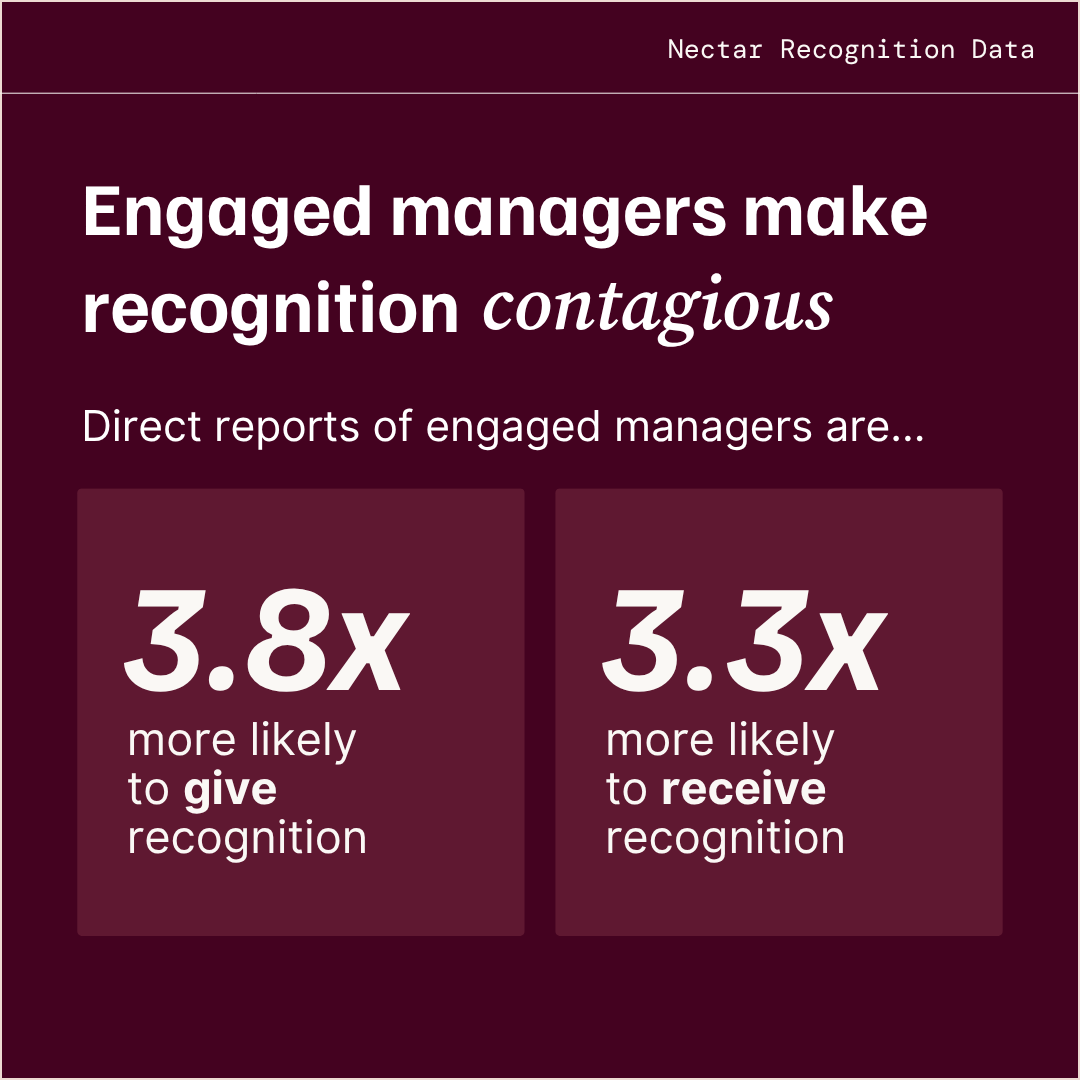
- Engaged managers mean engaged employees: Nectar data shows that engaged managers' teams are 3.8x more likely to give and 3.3x more likely to receive recognition.
- When managers disengage, teams follow: Gallup previously reported in the State of the Global Workforce that “70% of team engagement is attributable to the manager.”
- People leave if managers disengage: In our survey of 12,000 full-time employees in the United States, 55% of employees said they'd be likely to leave if their leaders appeared consistently disengaged.
- Regretted attrition is never just about money: A regretted departure carries costs most turnover dashboards don't show. The knowledge and client/deal context that leaves with the person and the strain it puts on the team left behind.
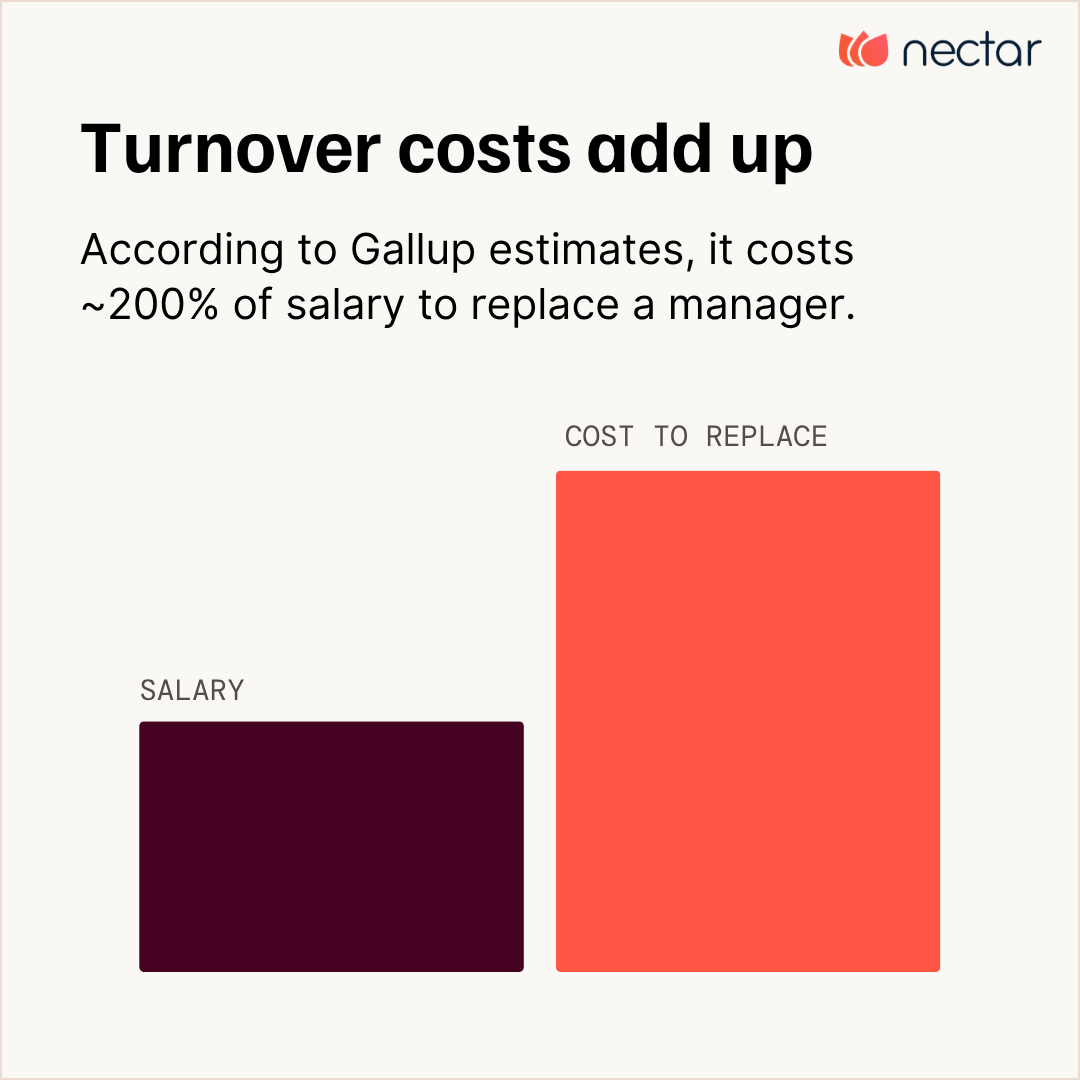
- But the money is huge: Even conservative replacement-cost math is daunting — and it doesn't price in any of the above. Previous estimations say that it costs ~200% of salary to replace managers and leaders.
While all turnover isn’t inherently bad, losing the wrong person at the wrong time — that unsavory regretted attrition — never saves your company. And it often doesn’t stop at just that one seat.
Loss of a top performer, no matter how you define “top,” likely pushes others out the door.
New Nectar research and first-party data sheds light on how you can fight voluntary attrition before it ripples through a team and where recognition breaks the pattern.
Recognition in the First 30 Days Predicts Who Stays
Analyzing Nectar’s own recognition data from 50,000+ employees, first-year employees recognized regularly were 18% less likely to leave within that first year.
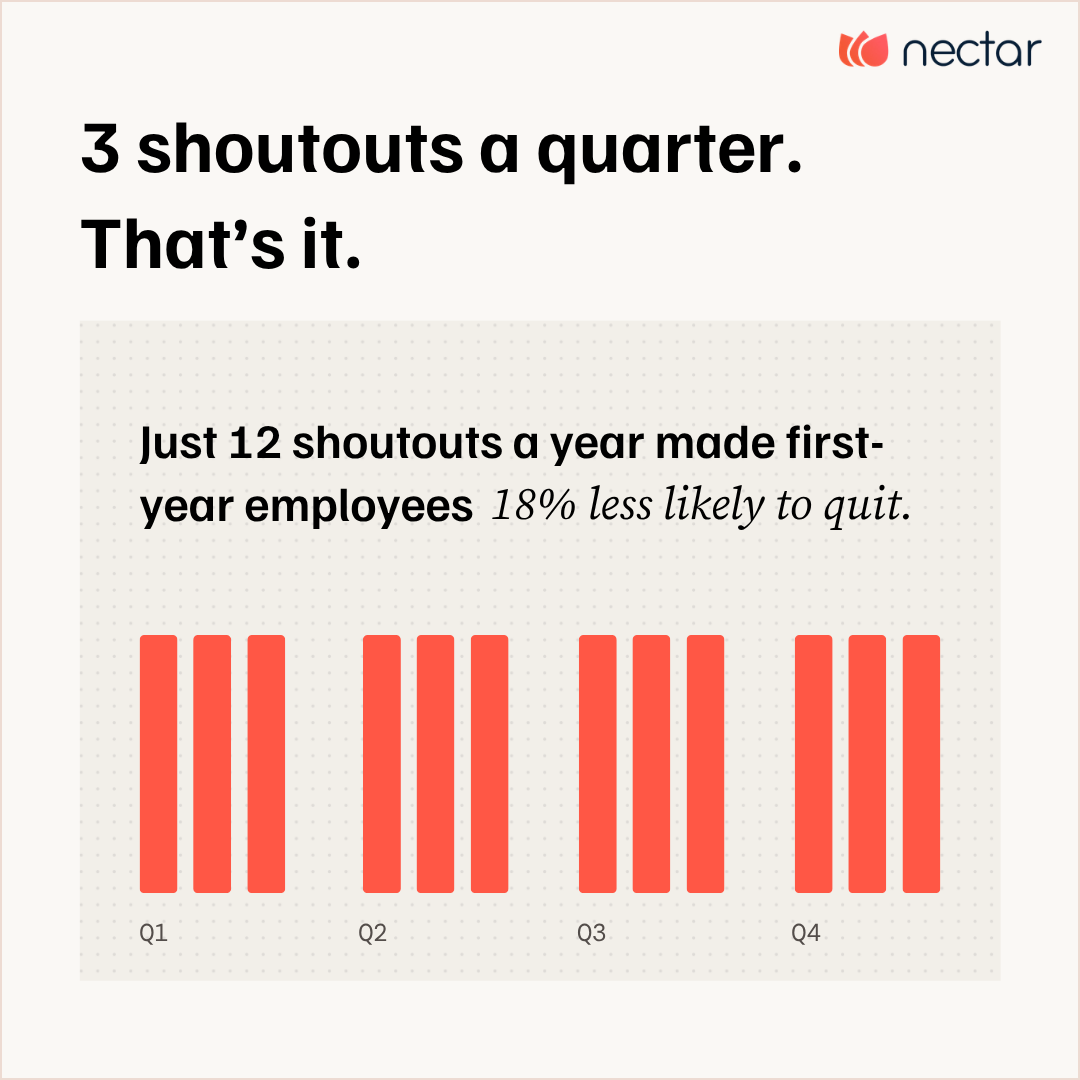
What counts as “regular” recognition? Just 1 shoutout per month (or 3 per quarter). We also found that consistent recognition continued influencing retention in the following year. Gallup research supports our own finding.
When they tracked 3,000+ employees from 2022–2024, they found that “well-recognized employees are 45% less likely to have left after two years.”
Regretted Attrition Won’t Stay Contained
When people watch a valued, visible employee check out or eventually resign, it raises their own flight risk. They examine their current role, worry about a potential increase in responsibilities, consider their options elsewhere, or question the company's trajectory.
The Manager Multiplier
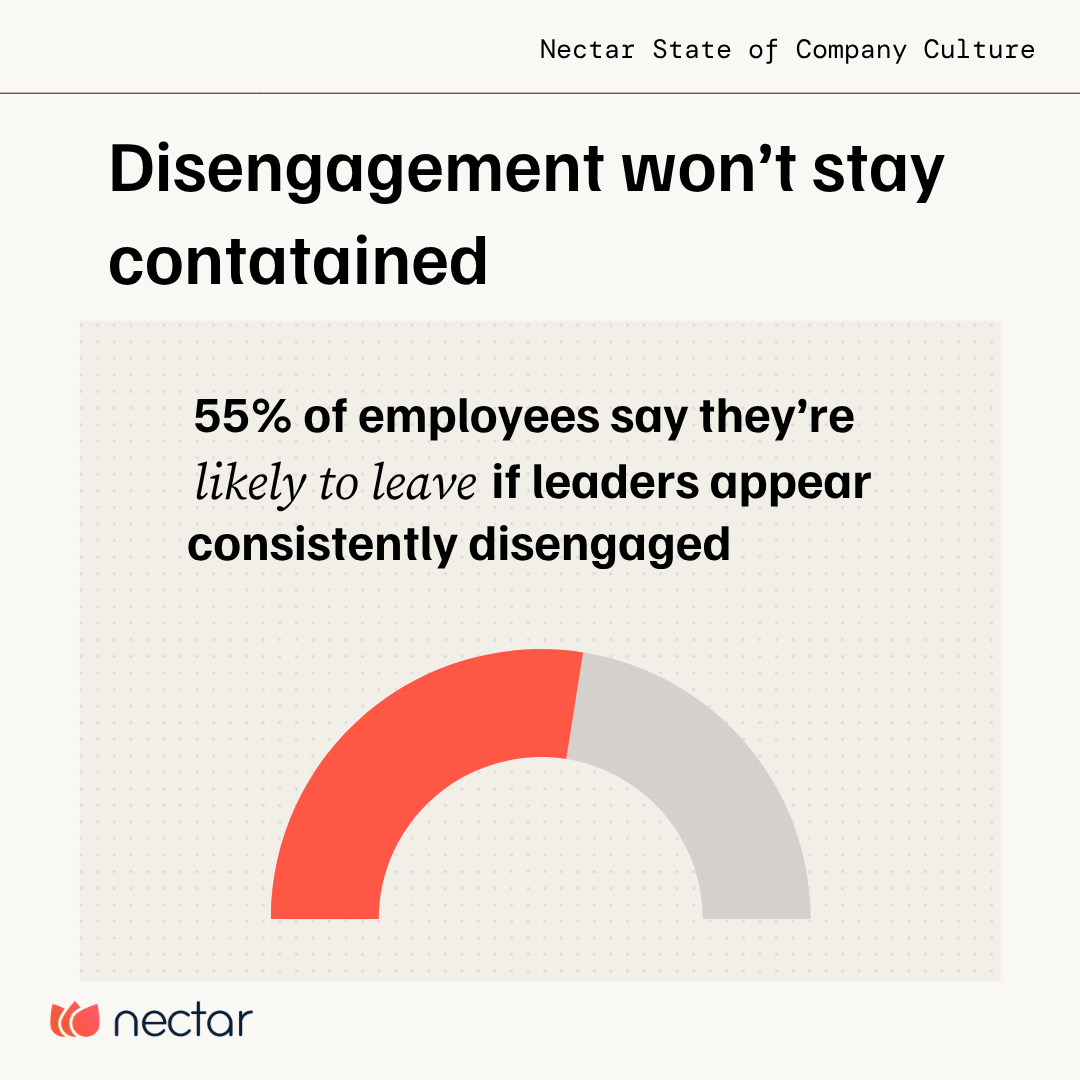
When we surveyed 12,000 full-time employees in the United States for the State of Company Culture Report, 55% of employees said they're likely to leave if leaders appear consistently disengaged.
A previous State of the Global Workplace report from Gallup found that 70% of team engagement can be attributed to their manager.
Both reports point to the same outcome: When managers disengage, teams follow suit.
Nectar found this to be true in our own recognition data. Based on the recognition of more than 50,000 employees using Nectar, engaged managers' direct reports are 3.8x more likely to give and 3.3x more likely to receive recognition.
What does an “engaged” manager look like? It takes a lot of forms, but here’s just one example from Ann Rhoades, former Chief People Officer at Southwest and a founding executive at JetBlue.
During her time as head of People, Southwest ran three reservation centers. Each one handled high-volume requests, battled high-turnover, and remained critical to the business. But one reservation center consistently outperformed the other two. Ann's team went looking for the difference.
One habit provided the answer. The manager walked the floor at the start of every shift and talked to every single employee. Her assistant manager did the same on the next shift. “Average turnover in a reservation center at that time was 25%, and she had 6%,” Ann explained.
They taught the habit to the other reservation center managers. Turnover dropped the same way.
The Early-Warning Pattern
Recognition remains a strong leading indicator of engagement and retention risk. Based on 1.2 million recognition events in Nectar from 40,000+ employees, when your most recognized people stop sending shoutouts for just one quarter, their chance of leaving within the year rises 67%.
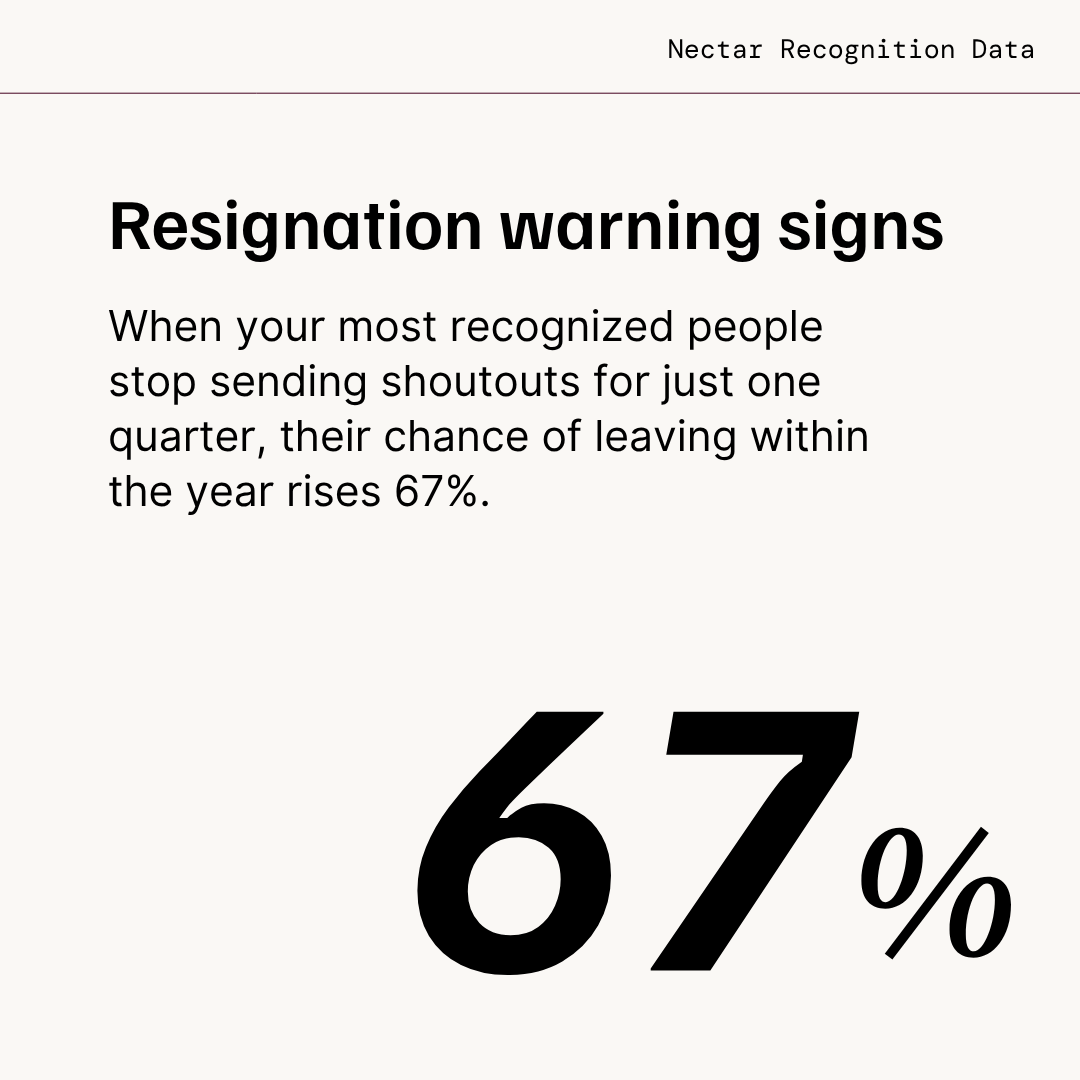
One surprise resignation won’t automatically cause another, but a drop in recognition is a detectable pattern you can watch among all employees. When you see employees not being recognized at all or employees stopping recognition, that’s your early warning sign.
Ann Rhoades heard the same thing from the people who actually left.
JetBlue followed a rule that within 24 hours of any resignation, a manager sat down with that person to find out why and whether it could still be turned around. Ann said that there was one pattern: "Consistently they say, 'I wasn't recognized for my performance.' Consistently. And they didn't think anyone cared about them. How simple is that, right?"
Address that risk and you potentially save your company a lot of trouble (and money).
Attrition Costs Beyond the Backfill
By the hard numbers, it can cost companies millions to replace employees (regardless of whether it counts as regretted attrition).
It’s estimated that replacing a manager costs roughly 200% of salary. That replacement costs about 80% for technical roles and 40% for frontline roles. That makes a manager's departure disproportionately expensive before you even factor in the team-wide multiplier.
But the qualitative costs of any attrition or turnover hit hard in a different way.
Knowledge and momentum walk out together
A regretted departure may risk client relationships built over years. Current team members scramble to find answers that before were always provided by their former coworker. Projects and goals get put on hold (or canceled completely) while a replacement gets up to speed. The loss of institutional knowledge probably can’t ever be quantified, but the remaining employees feel that loss every single day.
The team left behind absorbs the difference
You’ve probably experienced or watched a similar situation: One high-contributing individual employee leaves. Suddenly three separate employees (a combo of existing team members or new hires) cover what that one person had been handling alone. Or the work that one person was doing simply stops.
Sure, employees can pick up the slack for a while, but that stress adds up. Based on a SHRM report, 44% of U.S. employees report feeling burned out at work, and 51% feel "used up" by day's end. Absorbing the work of people who left doesn’t help workload.
HR teams and managers divert resources and attention
When you need to backfill, think about the work that goes into hiring. Managers and HR teams spend time writing job descriptions, recruiting, interviewing, preparing paperwork, running onboarding, training new hires, etc. That’s on top of all the normal tasks.
In many ways, hiring takes people away from the things you actually hired them to do. Of course you can’t avoid hiring. But when hiring tasks continually interrupt day-to-day work, tasks and deadlines get missed and employees burn themselves out to catch up on work. In the background, resentment builds toward the company.
What This Means for Your Organization
Recognition should be looked at org-wide as you assess the employee experience and associated risk. When you incorporate a recognition program into your retention plans, rather than treating it as a nice-to-have, you directly impact the company’s bottom line.
- Watch manager recognition activity as a team-level risk signal, not just an individual one.
- Prioritize recognition in the first 30–90 days.
- Build peer-to-peer participation, not just manager-led programs.
- Treat a drop in recognition around your most-visible people as a prompt to check in, not a countdown.
Recognition is retention infrastructure that you can implement in weeks, not months.
Wondering how to spot drops in engagement and recognition before it’s too late? Take a self-guided tour of Nectar Signals.

Anna Wendt is Nectar’s content marketing manager, researching and curating expert advice on employee recognition, retention, and engagement. When she’s not diving into the nitty gritty of HR, she can be found hiking with her dog Samwise, rock climbing, and creating art.